The discipline of getting recommended by AI.
Recommendation Design is the practice of closing the gap between what AI recommends about your brand and what you intend to be recommended for.
Built on the category-defining book that teaches the missing discipline: getting your brand recognised by a reasoning system. Not just found or cited.
Try it on your own brand today
One step left. A confirmation email is in your inbox. Click it, and your toolkit downloads.
That didn't send. Check the address and try once more.
The first email brings the toolkit: a worksheet and three prompts to run the practice. One email a week after that.
What's in the toolkit?· Unsubscribe anytime ·Terms
The five gates
How AI picks who to recommend
When a buyer asks AI for advice, the answer passes through five gates before anyone reads a word.
The AI breaks the question apart
One question like "who should we choose for this?" becomes 5 to 20 smaller questions behind the scenes.
It decides where to look
Web search, its own memory, databases. Each smaller question is sent to the right place.
It gathers candidates
SEO works hereThe AI pulls in pages and brands that might answer the question. If you're not in this pile, you don't exist. This is where you get found.
It judges who to trust
Recommendation Design works hereA judge inside the AI checks every candidate: is it relevant, recent, believable? About half of what gets found never survives this gate. This is where you get chosen, or eliminated.
It writes the answer
AEO works hereOnly now does the AI write the paragraph the buyer reads, quoting the survivors. This is where you get quoted.
The winner is picked at gate 04, before the answer is written.
Architecture: Mike King, iPullRank
The decision moved, and nobody moved with it.
Your buyer now asks a model who to choose, and mostly takes the answer. None of this shows up as a lost deal. It shows up as a deal that never appeared.
of B2B buyers used AI in their most recent purchase, up from 89% a year earlier.
Forrester, Buyers' Journey Survey 2026 · 18,000 buyers
chose a different software vendor than they had planned, on an AI chatbot's guidance.
G2, The Answer Economy 2026 · 1,076 buyers
What Recommendation Design is
One loop, run continuously, across the buyer's whole decision journey.
Recommendation Design is a repeatable practice: see what AI says about you, work out why it says it (the criteria it weighs, the risks it holds against you, the alternatives it names), and only then seed the evidence that changes the answer. Each pass checks whether the last one moved.
Observe
What AI says
Run the prompts your buyers actually use, at scale, across the models they use. Capture how ChatGPT, Claude, Gemini, and Perplexity describe you, what they cite, and where you never appear.
Decode
Why it says it
Extract the criteria AI applies in your category, and the risks it holds against you: the evidence it is missing, the objections it raises, the false beliefs sitting inside the recommendation. This is the step you cannot skip.
Seed
Change the answer
Only once the criteria and risks are decoded can you write the evidence that answers them, tied to a specific gap rather than generic content. Publish it, then observe again to see whether the answer moved.
02 · Decode
Decoding is finding the criteria your market and audience combination is judged by. Before you have them, you can't build the evidence.
What you decode sorts into four facets:
Elimination triggers
What disqualified you: the reasons AI cuts a brand from consideration entirely.
Buyer risks
What buyers fear might go wrong before anything has. The worry that later becomes the cut.
Switching hesitations
What slows the decision even when buyers want to choose you. Resolve them, and the deals that used to stall start closing.
Criteria gaps
What the model weighs when it compares. Own the criteria nobody else answers, and you can become the leading recommendation in your category.
Across 18 projects in 13 industries and four languages, thousands of unique phrasings consolidate into a finite, stable taxonomy. But the priority order changes by market and audience.
The toolkit
Find out where your brand gets cut, and why.
The manual practice is open to anyone. Sign up, and the first email brings the toolkit from the book: a one-page worksheet and three prompts for ChatGPT or Claude. Run them on your own brand today.
The diagnostic
One conversation that surfaces the criteria AI is weighing and the reasons your brand gets cut.
Brand & audience framework
A one-page worksheet that sharpens the inputs before you run the prompts. Crisper inputs, sharper answers. Eight fields, with a worked example.
An FAQ you can ship
The diagnostic tells you what the AI model needs to recommend your brand. Create the content to start closing the gap today.
After the toolkit, one email a week: what gets brands recommended, and how to shape the way AI talks about yours.
One email a week. Unsubscribe anytime.
One step left. A confirmation email is in your inbox. Click it, and your toolkit downloads.
That didn't send. Check the address and try once more.
AI searches happen in the background for every one visit your analytics attributes to AI.
the conversion rate of ChatGPT visitors against Google organic, in a B2B case study.
better conversion from AI-referred visitors than non-AI, across one trillion US retail visits. A year earlier: 38% worse.
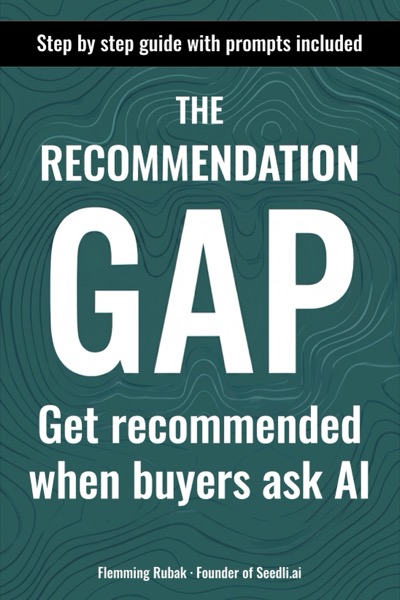
The foundational text
The Recommendation Gap
The book that named the category · Flemming Rubak
Marketing has a discipline for being found, and one for being remembered. It has none for being recognised by a reasoning system.
The Recommendation Gap names that missing discipline and lays out the manual practice in full: the observe-decode-seed loop, the prompts, and the worked examples. Everything on this site extends that foundation.
Kindle on Amazon, or every other store (Apple Books, Kobo, and more) via one page.
When manual stops scaling
The discipline is free. The instrument is for when you outgrow doing it by hand.
You can run Recommendation Design by hand for one brand. Across a portfolio of brands and categories on a weekly cadence, the observation work outgrows a person. That is the job Seedli does. Start by hand. Move to the instrument when the work earns it.
See the instrument